
Stellantis Investor Day outlined a detailed relaunch plan for the group’s American brands as well, with a strategy that gives Dodge, Jeep, Ram and Chrysler distinct and complementary roles in the North American market. The plan includes the introduction of several new models by 2030.
Dodge Copperhead, Jeep Scrambler, Ram Dakota and new Chrysler SUVs lead Stellantis’ plan

Dodge will receive the strongest dose of performance through a new muscle car, still shown in camouflaged form, with aggressive proportions, a long hood, a squared-off front end and a large rear wing. The American press suggests it could carry the Copperhead name, a badge Dodge has already used in the past and one inspired by a venomous snake. However, the V8 hypothesis has recently lost strength.
The model should also arrive in an SRT version, a performance badge Dodge plans to extend soon to the Charger. Alongside the new sports car, Dodge will also introduce a crossover called GLH, designed to inherit the role of the Hornet, with a possible SRT version in this case too.
Jeep will add the Wrangler Scrambler to the already announced Cherokee and Recon, creating a model designed to strengthen the brand’s adventurous and off-road character with an approach close to the Gladiator’s philosophy. The SRT badge should also return on the Grand Cherokee and Grand Wagoneer, confirming the intention to preserve a performance component even on larger SUVs.
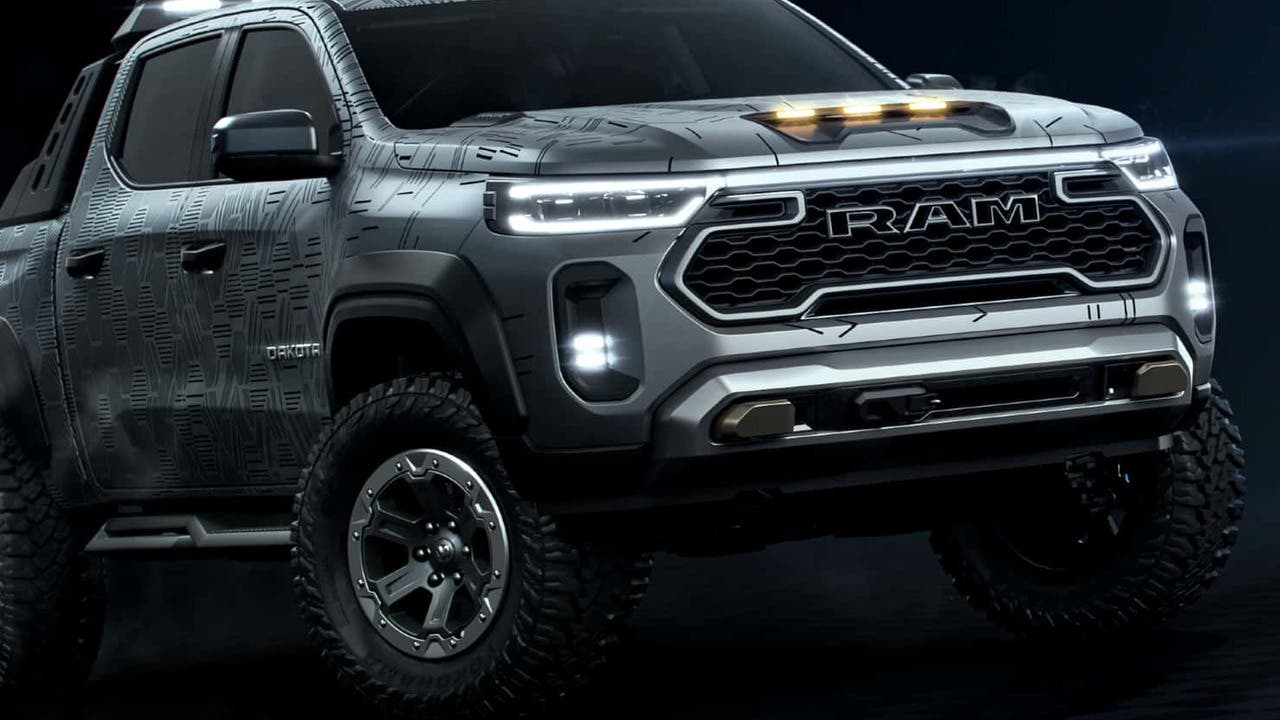
Ram will introduce the new Dakota, a pickup designed to bring the brand back into a smaller segment than traditional full-size trucks. It will join the Ramcharger, a large SUV that could become one of the most important new entries in the group’s American lineup. Both models should offer SRT versions.
Chrysler, meanwhile, will take on the most accessible and rational positioning, with three crossovers planned under the Airflow, Arrow and Arrow Cross names. The last two should derive technically from European group models such as the Citroën C3 Aircross and Opel Frontera, adapted for the North American market and reinterpreted through Chrysler’s design language. This strategy would allow Stellantis to contain development costs by using platforms and components already available within the group.