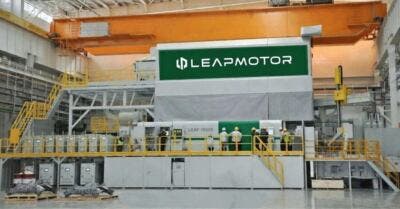
Leapmotor is building a dedicated gigacasting supply chain in Jinhua, China, involving two specialized suppliers and targeting a total capacity of 450,000 integrated structural castings per year once fully operational. The project, reported by Industry Arsenal, represents an estimated investment of around 300 million yuan, equal to about €38 million or roughly $41 million, for the Stellantis-backed Chinese automaker. Its goal is to reduce the number of body components and shorten assembly times.
Stellantis-backed Leapmotor invests in large-scale gigacasting

Citic Dicastal handles production of the front castings and has already launched a line equipped with a 10,000-ton Yizumi press and a two-cavity mold. This first phase has an estimated capacity of 300,000 front elements per year, with each finished part weighing around 34.3 kg. Citic Dicastal’s plan includes a second step with the installation of a 7,500-ton machine for the production of 120,000 rear castings per year, bringing the plant to its planned overall capacity.
Duoli Technology, meanwhile, handles the castings for the rear section of the floorpan. In January 2026, the company opened a new foundry, also in Jinhua, equipped with a 9,200-ton Bühler Carat 920 press. Bühler had previously announced an order from Duoli for four systems of this type, highlighting the particularly large size of the Carat 920.
Leapmotor’s approach, however, appears more gradual than the most extreme gigacasting applications adopted by other automakers. The front component, for example, does not integrate elements such as shock towers or large wheel arches. That choice makes the solution less radical, but probably easier to adapt to the vehicle structure and more manageable during maintenance and repairs.

This strategy may reflect Leapmotor’s intention to introduce the technology progressively, while limiting the risks linked to an overly complex casting before gaining enough production experience.
For Stellantis, which owns a stake in the Chinese group and distributes its models in Europe through Leapmotor International, this supply chain could provide direct access to expertise and manufacturing capacity in large structural castings, an area that will likely play a growing role in the automotive industry over the coming years.