


In a garage in Utah, the legendary durability of 1980s Japanese engineering has collided with the high-voltage sorcery of the 21st century. An enthusiast has successfully performed what can only be described as a “sacrilegious” masterpiece. It’s a Tesla Model 3 drive unit into a boxy 1987 Toyota Hilux.
While the Toyota Hilux is world-renowned for being indestructible, it has never, in its forty years of existence, been accused of being fast. Until now. Documented by the YouTube channel Electric Supercar, this project evolved from a weekend hobby into a rolling science experiment.
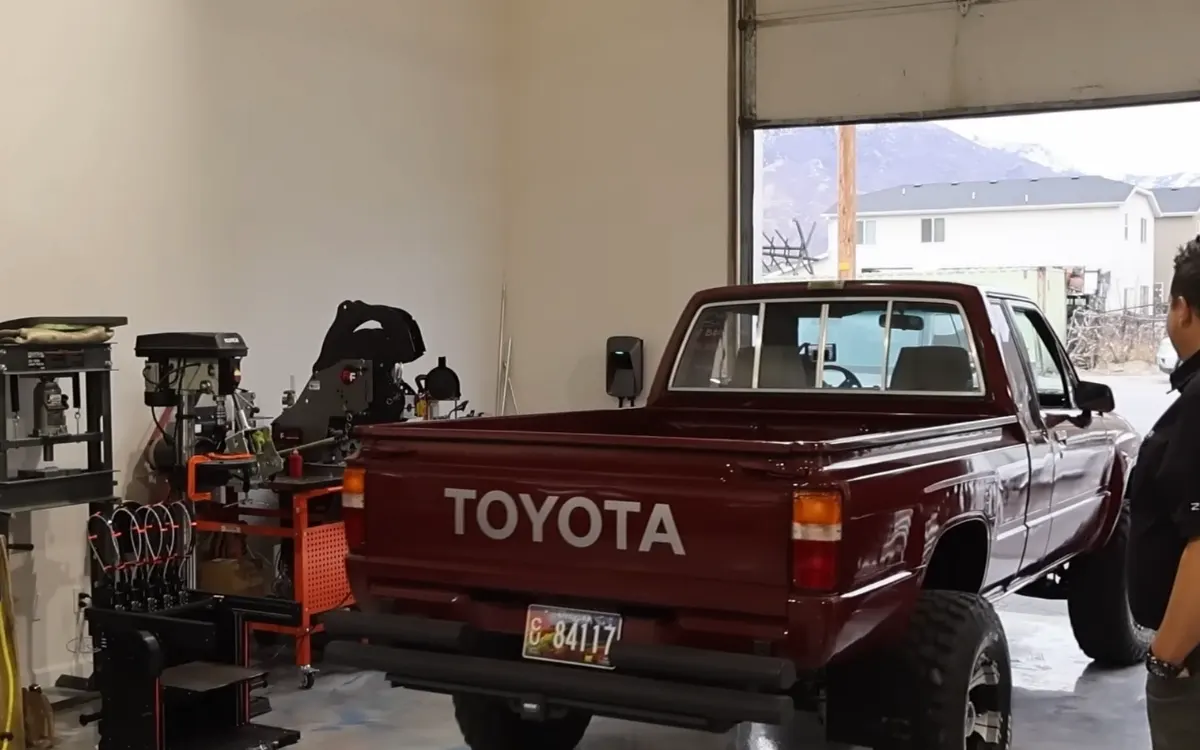
The team didn’t just stop at the motor. They gutted the internal combustion hardware to make room for custom battery packs, an electric power steering system, and a sophisticated DC-DC converter. They even engineered a bespoke cooling system, neatly tucked behind the original factory grille to keep the truck looking like a humble farm hand rather than a silent assassin.
The road to instant torque wasn’t without its “explosive” moments. Initial tests were met with ominous silence, cryptic error codes, and a series of loud bangs that suggested the truck was rejecting its new Californian organs. But they were also using a Tesla Model S accelerator pedal, which apparently speaks a different dialect than the Model 3 motor. Once the correct pedal was installed and a sketchy ground wire was fixed, the “Frankenstein” Toyota finally roared to life.

Even with a temporary 3D-printed throttle bracket, the electrified Toyota Hilux proved to be incredibly responsive. The regenerative braking bites hard, the cabin heater provides instant warmth, and the truck handles its new power with surprising cleanliness. There are still a few “EV quirks,” like occasional power limiting under heavy acceleration, but the transformation is a triumph of DIY engineering.
With Toyota set to launch an official all-electric Hilux in 2026, this Utah man hasn’t just built a cool truck. He’s given the world a sneak peek at the future.