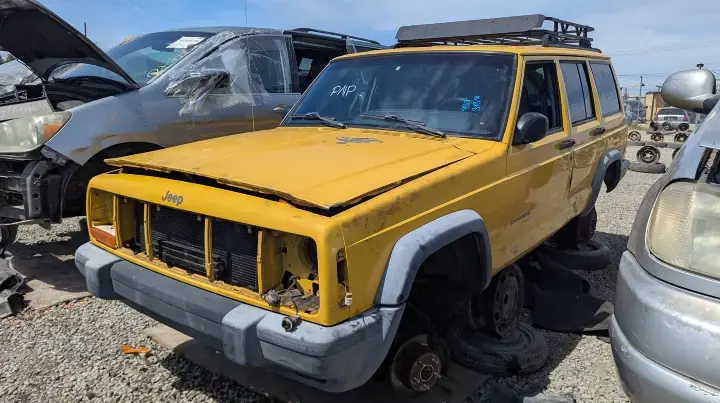
Junkyards hold the visceral, unvarnished history that squeaky-clean automotive museums are simply too polite to curate. Take this 2000 Jeep Cherokee XJ Freedom Edition, currently resting its weary, rusted bones in a California Pick-n-Pull yard. It sits just down the street from a gleaming Tesla factory. A rotting monument to old-school internal combustion decaying right in the shadow of the new electric empire.
This Cherokee is one of only 2,821 Freedom Editions baked by Daimler-Chrysler for the 2000 and 2001 model years. Granted, it is not a mythical unicorn, but it certainly deserves a sweeter swan song than a date with the industrial crusher.
The XJ Cherokee was a seismic cultural shift that quite literally taught Americans how to drive SUVs. In an era when the US government deemed American Motors “small enough to fail,” Renault stepped in with a savior package that included legendary engineer François Castaing and his squad of French designers. Their 1984 masterpiece permanently rewrote global automotive tastes.
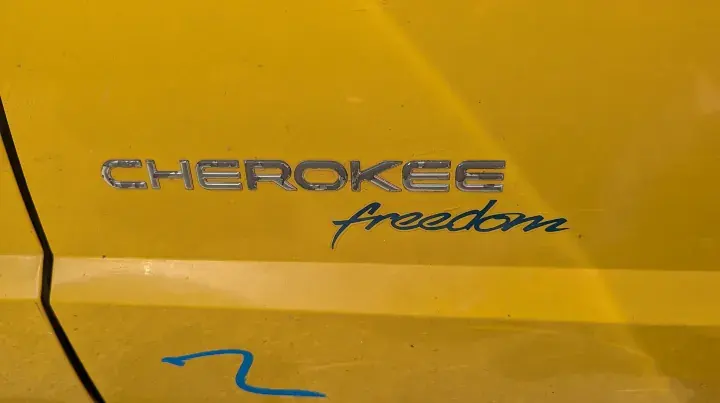
Strip away the marketing romanticism, and this Freedom Edition was basically a base Sport trim dressed up with 16-inch alloy wheels, color-matched black bumpers, a chrome grille, and a CD/cassette player.
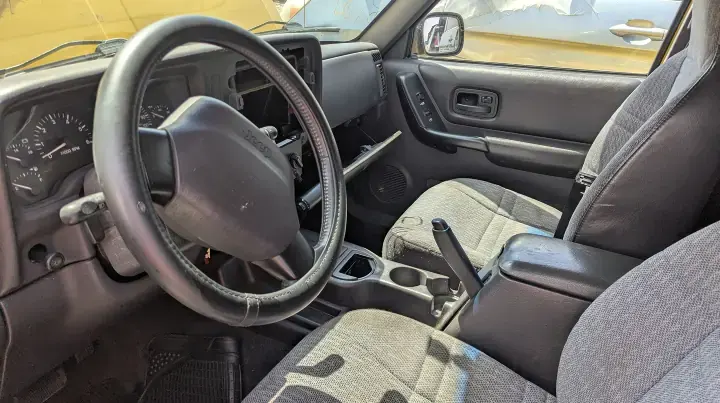
Today, this Solar Yellow survivor has been picked clean. The alloys are gone, the black trim has faded into an existential gray, and the chrome is a distant memory. Underneath lies the immortal 4.0-liter AMC inline-six, pushing 193 HP and 231 lb-ft of torque through a bulletproof four-speed Aisin automatic.
The rear window stickers tell the final, poignant human chapter of this truck: Jump Wings, an Explosive Ordnance Disposal badge, and an 82nd Airborne Division patch. A real-world veteran drove this thing into the ground before it was discarded here. Daimler-Chrysler knew exactly what it was doing in the early 2000s, riding a wave of aggressively patriotic nomenclature. This yellow Cherokee simply caught the vibe early.