A document from the California Air Resources Board has finally revealed the detailed battery capacities of the Tesla Semi, a figure the automaker had never officially disclosed and that until now had remained the subject of estimates and rough calculations by analysts and enthusiasts.
Tesla Semi battery impresses as official capacity figures emerge

The Long Range version has a battery with 822 kWh of usable capacity. Based on a stated consumption of around 1.7 kWh per mile, it would provide a theoretical maximum range of about 483 miles, or just under 780 km. That figure sits slightly below the 500 miles promised by Tesla, although it would still require starting with a full charge and using almost all the available energy. This configuration has a curb weight of around 23,000 pounds, equal to about 10.4 tons, while gross combined weight reaches 82,000 pounds, or about 37.2 tons. Maximum output stands at 800 kW, delivered by three electric motors mounted on the rear axles.
The Standard Range version uses a battery pack with 548 kWh of usable capacity. With the same average consumption, it would offer a theoretical range of around 322 miles, largely in line with the 325 miles stated by Tesla. Curb weight drops below 20,000 pounds, or under 9.1 tons, while gross combined weight remains identical to the Long Range version. On the power side, the CARB document lists a maximum output of 525 kW, although Tesla’s official website gives both versions 800 kW. Dan Priestley, head of the Semi program, recently clarified that the company offers different 525 kW and 800 kW configurations.
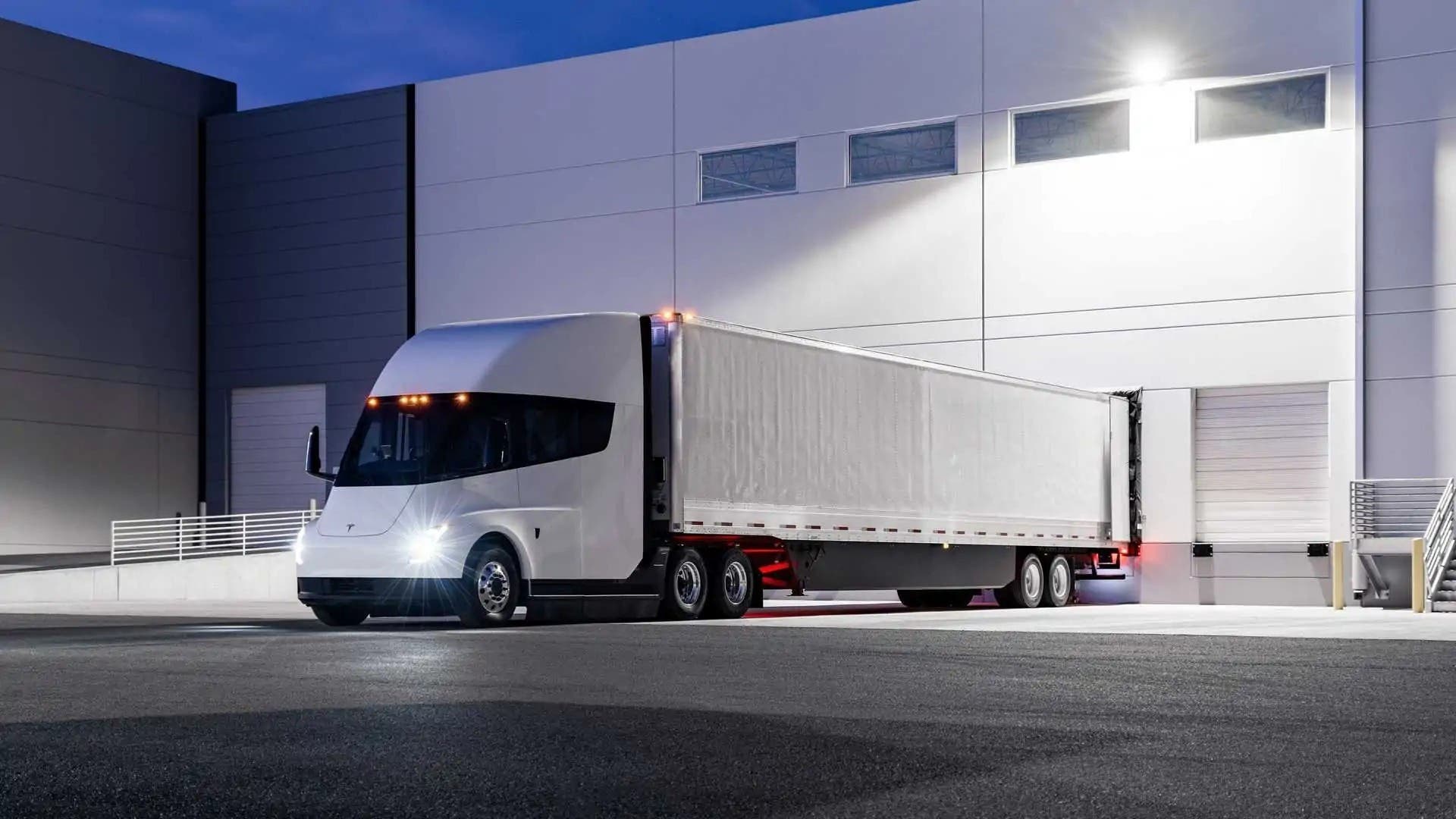
Both variants use 4680 lithium-ion cells with nickel-manganese oxide chemistry, the same adopted by the Cybertruck. The battery packs sit within the truck’s floor to keep the center of gravity as low as possible. The Long Range version also uses a longer frame than the Standard Range model to accommodate the larger battery pack. As for charging, the Tesla Semi can accept up to 1.2 MW through an MCS 3.2 port, and Tesla has introduced a dedicated new Megacharger capable of bringing the truck to 60% charge in about 30 minutes. The offering also includes the Basecharger, a 125 kW unit that does not require a dedicated power cabinet.
Mass production of the Semi has only recently begun, and the first customer deliveries should take place by the end of the year. Its technical sheet focuses on very large battery packs, ultra-high-power charging and ranges designed to make electric propulsion a concrete option even in the long-haul heavy-duty transport segment.