Luxembourg is becoming Europe’s new testing ground for autonomous driving. Bolt, Pony.ai and Stellantis have announced a joint trial program dedicated to driverless vehicles, with the aim of assessing in real-world conditions whether technology, operational management and the regulatory framework are truly ready to work together.
The choice of country does not seem accidental. The small European state offers a progressive approach to testing and allows direct dialogue between technology companies, carmakers and regulatory authorities, a condition that is difficult to replicate elsewhere. James Peng, founder and CEO of Pony.ai, described Luxembourg’s regulatory environment as a useful basis for validating autonomous technology in the European market. Markus Villig, founder and CEO of Bolt, also pointed to the same environment as favourable ground for the company’s first pilot project in autonomous mobility.
Bolt, Pony.ai and Stellantis launch autonomous vehicle tests in Luxembourg

From a technical point of view, the tests will focus on Pony.ai’s seventh-generation autonomous vehicles, which will have to prove their reliability in everyday traffic. Urban driving remains one of the most complex environments for driverless technology, because it requires constant reactions, the ability to read the behaviour of other road users and the capacity to adapt to unpredictable situations.
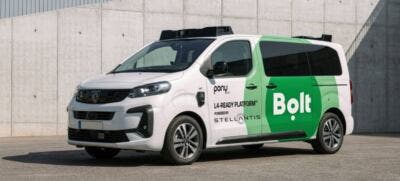
Stellantis will provide the industrial contribution by supplying a mid-size van based on its L4-Ready Platform, an architecture designed to integrate Level 4 autonomous driving systems. This is a significant element, because the trial will not focus only on software, but on the entire vehicle, from sensor integration to electronic management, safety and the possibility of replicating the solution across different vehicle categories. According to Ned Curic, Chief Engineering and Technology Officer at Stellantis, the L4-Ready platforms are designed to be flexible and scalable, and can apply to different types of vehicles.

Bolt, meanwhile, will bring its experience in ride-hailing and urban mobility service management. The program will cover the entire operational chain, from road deployment to fleet management, from digital platform integration to engagement with authorities, including booking, supervision, maintenance and route planning. After all, an autonomous service does not depend only on a vehicle’s ability to move without a driver, but on everything that surrounds it.
The initiative forms part of the Living Lab, an urban laboratory created to validate technologies and processes in real conditions. The testing phase aims to reach full readiness for completely driverless operations, with the prospect of extending the model to other European cities if results prove positive. For autonomous mobility in the Old Continent, still far from mass deployment, this would represent a shift from controlled trials to direct confrontation with the real complexity of everyday traffic.