

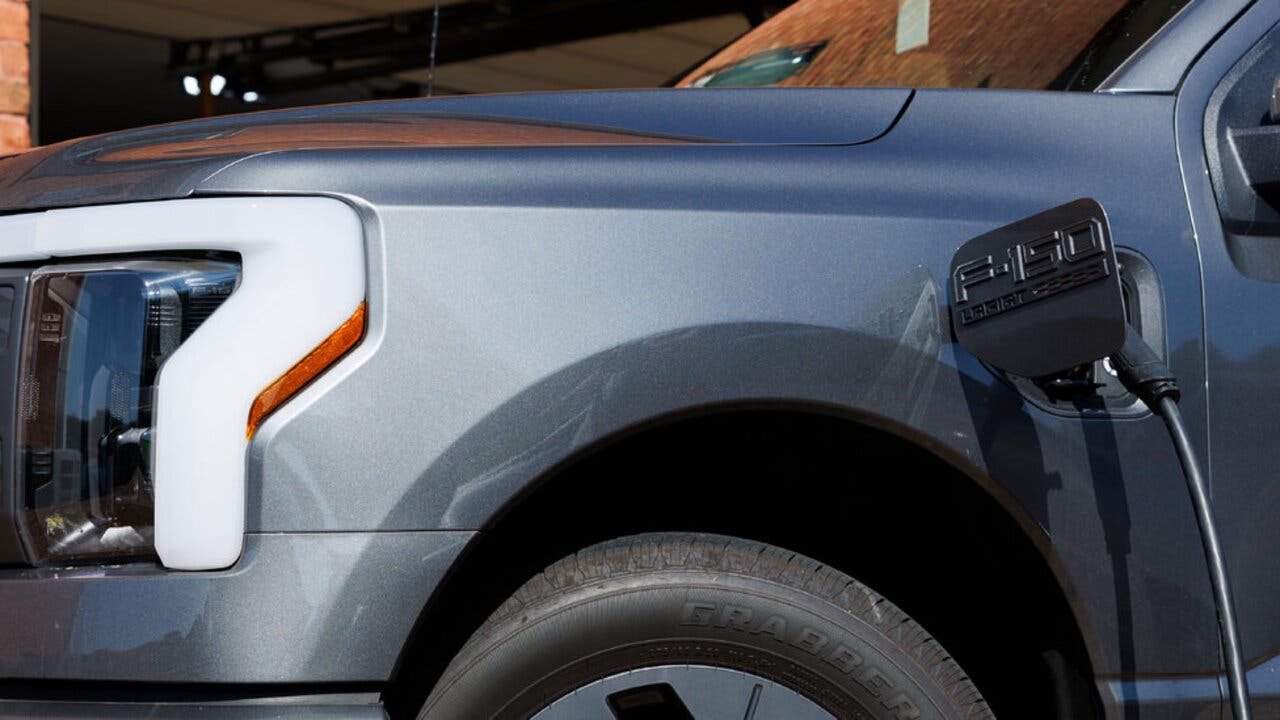
Ford’s Model E division, the arm of the company supposedly hauling the Dearborn giant into a sparkling, emission-free future, just closed out 2025 with operating losses of $4.8 billion. That is not a typo. We are talking about nearly five billion dollars evaporated in a single year on a revenue stream of just $6.7 billion. Losing almost as much as you earn isn’t exactly a sustainable business model.
The current Model E lineup looks respectable enough on paper, featuring the Mustang Mach-E, the F-150 Lightning, and the European-made Explorer and Capri. However, the F-150 Lightning was politely “suspended” from production during the latter half of 2025, presumably because building it was becoming a bit too expensive of a hobby. Meanwhile, the electric vans have cleverly hidden themselves under the Ford Pro division, clearly wanting absolutely nothing to do with this financial shipwreck.

The horror story deepens in the fourth quarter, where Ford had to record write-offs totaling $10.7 billion. Why? Because they finally admitted that several high-profile programs, including the next-gen Project T3 electric pickup, will never actually see the light of day. By December, the total amount of announced devaluations hit a staggering $19.5 billion.
Ironically, Ford is desperately pointing to “signs of improvement”. Revenues actually grew by 73%, but since losses only shrank by a negligible 9.4%, the math remains grim. Ford is effectively selling more cars just to lose nearly the same amount of money, crushed by fixed costs that even higher volumes can’t seem to outrun.

The Model E represents a measly 3.6% of Ford’s total $187.3 billion revenue for 2025, yet it absorbs massive losses that the profitable, gas-chugging divisions are forced to cover. For 2026, Ford is forecasting a “slight improvement”, with losses “dropping” to somewhere between $4.0 and $4.5 billion.
With another $7 billion in write-offs to be spread across 2026 and 2027, the Ford electric transition has become a fascinating stress test to see exactly how much a balance sheet can bleed before it simply stops moving.