Ferrari continues to explore unusual ways to extract performance even from elements usually seen as enemies of a sports car, and heat is one of them. A new patent filed in the United States and discovered by CarBuzz reveals a solution with clear links to the aviation world. Ferrari is reportedly studying a system that can recover part of the thermal energy produced by the exhaust and turn it into a small amount of additional thrust.
Ferrari patent turns exhaust heat into thrust using aviation-inspired logic
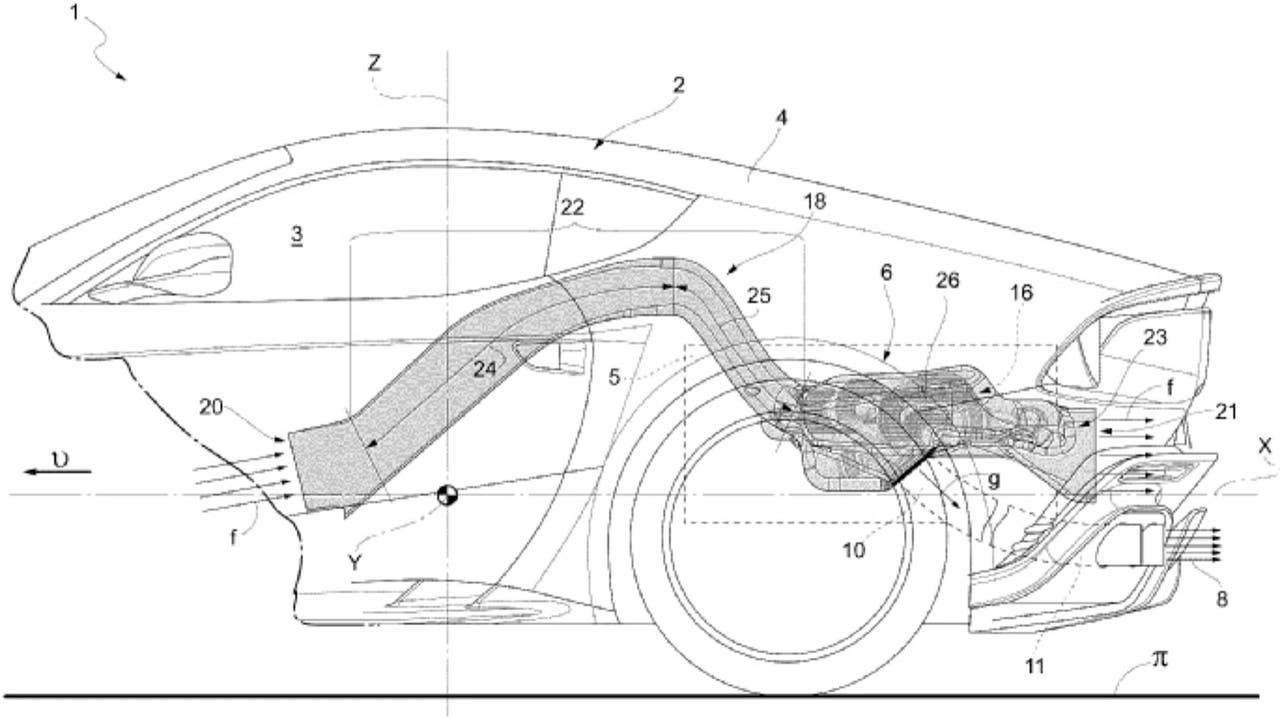
The document describes a heat exchanger integrated into the exhaust system, with a finned manifold designed to dissipate thermal energy from combustion gases more effectively. A hollow duct would run next to this component, carrying air drawn from outside the car. As this air passes near the hottest areas of the engine, it would absorb part of the heat before being expelled. Even this function alone would prove useful, because it would lower the temperature of components exposed to extreme stress. Ferrari, however, appears to have imagined a further step.
At the outlet of the duct, a nozzle would accelerate the heated air and generate a small forward thrust component. The effect would obviously remain limited, but the physical principle is interesting and linked to the so-called enthalpy jump. The heat transferred to the air increases its energy and pressure, making the final expulsion more effective. In practice, Ferrari is studying a way to turn part of the energy normally lost to the environment into useful work.
A crucial aspect of the patent is that the system would not act directly on the exhaust gases. This avoids any increase in back pressure and therefore prevents penalties in engine response. On a supercar, this detail matters enormously, because every change to the exhaust system must be calibrated with extreme care. Better cooling would make little sense if it caused a loss of power or reduced engine sharpness.
Heat management is never a secondary issue on supercars. Brake fluid, catalytic converters, cooling systems, turbochargers and exhaust components must stay within precise temperature windows, otherwise efficiency drops and wear accelerates. Tyres, on the other hand, need to reach the right temperature to deliver maximum grip. When heat becomes excessive, especially around the manifold area, material stress and the risk of performance loss increase quickly. More effective cooling therefore becomes a matter of both reliability and efficiency.
As often happens, a patent does not guarantee that the technology will reach a production model. Ferrari studies many solutions that remain confined to research. Still, the document shows how Maranello continues to work even on extreme details, looking for performance where others see only a problem to contain.