Ferrari continues to keep the door open to hydrogen, and a new patent makes clear that Maranello is studying the subject seriously. The company has not announced any model yet, and it has not confirmed a hydrogen-powered supercar, but the document filed by Ferrari shows where its research department may be working. The most interesting detail does not concern the engine, but the fuel storage system.
Ferrari hydrogen patent reveals flexible tank idea for future supercars
Hydrogen can power a fuel cell to generate electricity or burn directly inside a combustion engine, but in both cases the car must store it on board at very high pressure. Today, hydrogen cars mainly use rigid cylindrical tanks. These tanks are strong and safe, but they are difficult to integrate into a sports car. On a Ferrari, every centimetre matters, because the engine, cabin, aerodynamics, cooling, suspension and weight distribution must all coexist within extremely tight packaging limits. Large cylinders would create a major technical challenge.
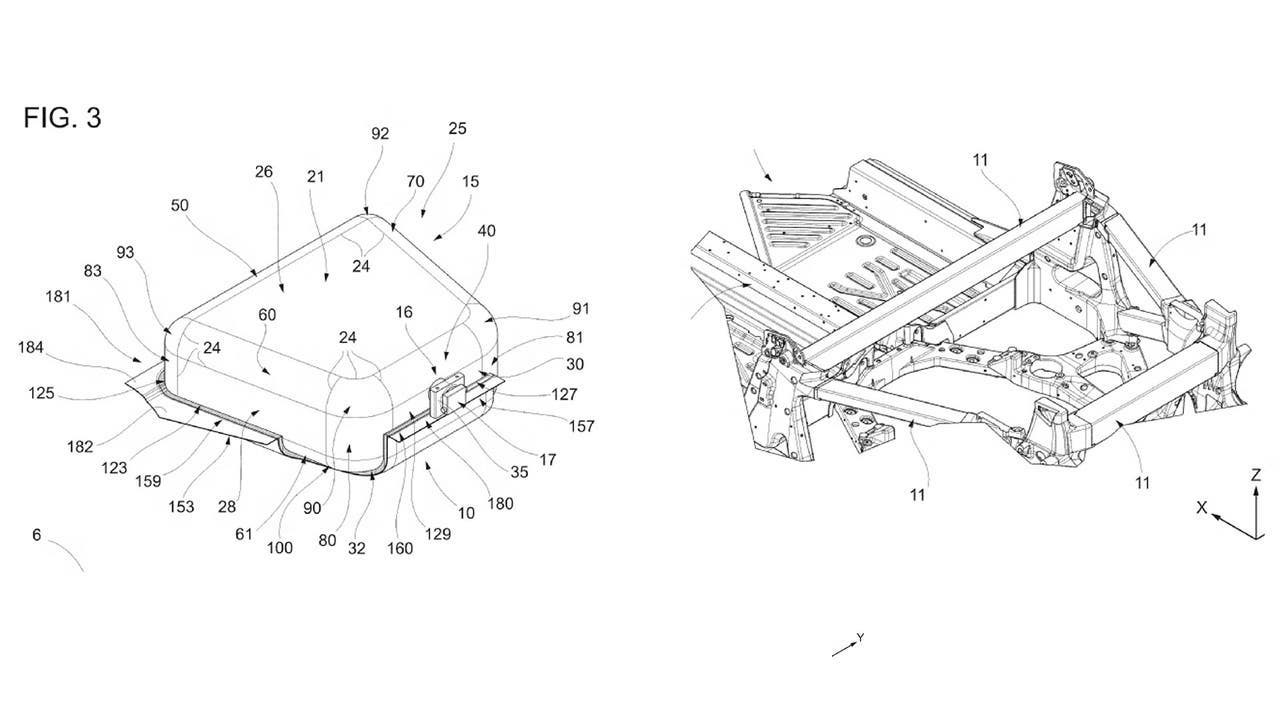
The solution described in the patent takes a different route. Ferrari appears to have imagined a tank made from a flexible material that can deform. During refuelling, the container would expand. As the car consumes hydrogen, it would contract again. Since the tank would not need to follow a fixed cylindrical shape, it could adapt more easily to the available space inside the car and use areas that would otherwise remain unused.
The real challenge concerns reliability. If the tank changes shape, the connections must remain stable, and the fittings cannot move, bend or suffer excessive stress. In a high-pressure system, even a small weakness could have serious consequences. For this reason, much of the patent focuses on connection points and ducts, the areas that must guarantee a perfect seal while the container expands or contracts.
Judging from the patent drawings, the tank would sit high in the rear section of the car, behind the cabin. This choice would significantly change the vehicle architecture, because on many Ferraris that area usually houses the engine or other mechanical components. However, hydrogen itself weighs much less than petrol, so its effect on overall mass would remain limited. The real weight issue would come from the containment system and its protective structures.
As always, a patent does not mean Ferrari will launch a production model soon. Carmakers study many technologies, and not all of them reach the road. Still, the document confirms that Maranello still sees hydrogen as a possible alternative, alongside the electric path already opened by the Luce, to preserve performance and range without abandoning the brand’s sporting identity.